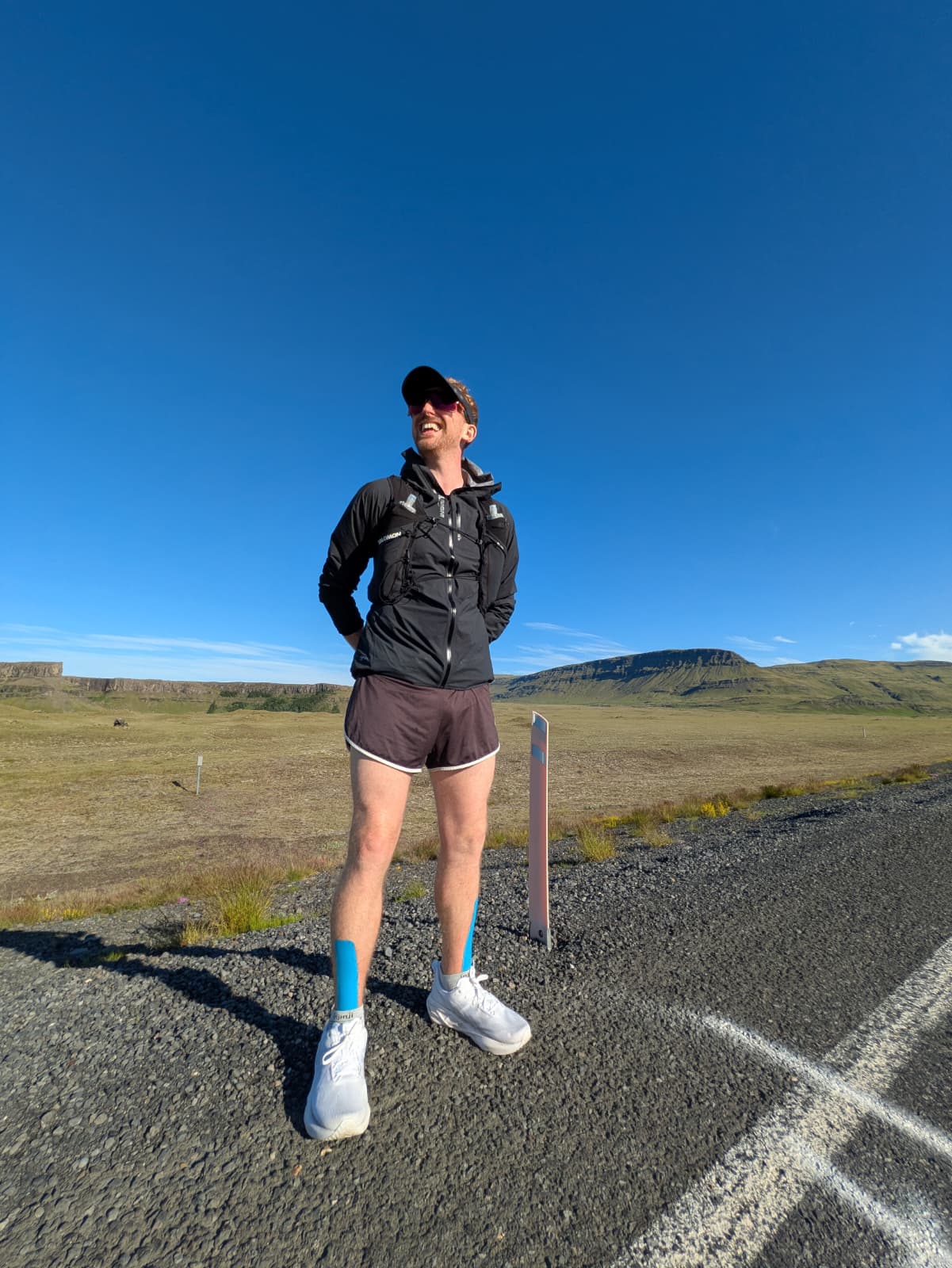
A year ago, my patient, Tom, casually mentioned that he was considering running around Iceland. He kindly offered to include me in this incredible journey as his osteopath. At the time, I didn’t realise the scale of the challenge, but I remember feeling excited by it. As a lover of sporting challenges and a keen traveller, this project immediately called my name, and I accepted his offer without hesitation. And that is how I found myself flying to Iceland on 12 July, with massage oil, K- tape, a stethoscope and a patella hammer packed in my bag.
Let me pre-empt you by saying that this experience has been a turning point in my career. I learnt so much from accompanying Tom on this herculean journey. It was also a beautiful human experience, sharing the adventure with three unique people: Tom the runner, Tom the driver and Freddie the videographer.
The initial plan was to run approximately 100 km per day for 13 days, completing the full circle of Iceland. For those of you who aren't familiar with Iceland, the country is encircled by Route 1, also known as the Ring Road. It stretches for approximately 1,350 km, meaning Tom was planning to run the equivalent of around two and a half marathons every day, for 13 consecutive days.
Day 1: Into the Elements
The first day of the challenge was horrendous due to the weather conditions, but Tom put in a phenomenal performance. The sky was low, the rain was relentless and the wind was blowing directly into his face. I don't know how he managed it, but somehow he ran 105 km that day. The team and I met him three or four times throughout the day to provide carbohydrate-dense food and replenish his water bottles with electrolytes. Tom even had his first Icelandic hot dog for lunch.
At the end of the day, I gave him an osteopathic treatment to reduce the muscle stiffness that had built up throughout the day. The aim was to help him wake up the following morning with manageable levels of stiffness and, hopefully, enough mobility to keep going.
Day 2–3: When the Body Starts Speaking
The following day, Tom already needed more support. His ankles had started to become inflamed, and the fascia around the area was under significant stress. For those of you who run long distances, you may have experienced the crackling or creaking sensation around the ankles that can occur when the tissues are under considerable strain.
I started using kinesiology tape to support his ankles. It appeared to help, and by the end of the day the tissues around the ankles felt more functional. However, the swelling remained, and that was becoming a concern.
As an ultra-runner, taking high doses of ibuprofen is generally not recommended because of the potential additional stress it can place on the kidneys, particularly in the context of prolonged endurance exercise and dehydration. Aside from lymphatic drainage, our main option for managing the inflammation was therefore cold therapy.
Unfortunately, being in a campervan meant we didn't have the luxury of an ice bath. We only had instant ice packs with us. This meant we had limited options for managing the inflammation in his ankles.
Day 4: The Warning Signs
On day 4, Tom started experiencing pain in both knees, as well as pain around the left hip flexor. Thankfully, there were no clinical signs suggesting a fracture, significant ligamentous injury or a meniscal tear. However, the pain was very real, with symptoms consistent with anterior patellofemoral pain and significant psoas fatigue.
I applied tape to his knees, iced them and gave him exercises designed to help him activate his quadriceps more efficiently. Unfortunately, by this point, I think his quadriceps and psoas muscles had reached their limit.
Tom tried to persevere, using walking poles and "Jeffing" — a combination of jogging and walking. Despite the enormous stress his body was under, he impressively managed to cover another 56 km that day.
Day 5: Knowing When to Stop
On day 5, Tom started the day with the same determination that had carried him through the previous four days. But as he ran towards Diamond Beach, he made the incredibly difficult decision to end the challenge.
His target had been to break a world record. However, as it became increasingly clear that he would not be able to reach that goal, he made the wise decision to stop and give the challenge another go in a few years' time.
The whole team had to reassess our expectations that day. We had been prepared to live this intense cycle of seeing Tom run day after day, supporting him with food and hydration, following him in the van, doing warm-ups in the morning and osteopathy treatments at 10.00pm, and sleeping at a campsite every night.
But the challenge had to end there. By that point, Tom had pushed his physical boundaries far enough.
378 km in Five Days
This became particularly apparent when I reassessed him after he stopped. His left psoas simply wouldn't cooperate anymore. He couldn't lift his left leg off the floor in a seated position, and he struggled to fully extend either knee. Initially, even going up and down stairs felt almost impossible.
His body had allowed him to go an extraordinary distance — 378 km in just five days — but it had come at a high price.
The Recovery
Taking Tom through his recovery was immensely inspiring. On the first day, movement through his hips and knees was extremely limited. He also still had significant swelling around his ankles. I used a combination of lymphatic drainage, deep-tissue massage and articulation work to kick- start his recovery. We also incorporated daily rehabilitation exercises to gradually restore movement and function. Towards the end of what had unexpectedly become a rehabilitation holiday, Tom was finally able to walk like a normal human being again.
For me, the experience was about much more than the physical challenge. It was a lesson in resilience, adaptation and knowing when to push forward — and, perhaps even more importantly, when to stop.
I went to Iceland expecting to support an ultra-runner through one of the most demanding physical challenges imaginable. I came back having learnt an enormous amount about the human body, endurance, recovery and the privilege of being part of someone's journey when they push themselves beyond what they thought was possible.